
Bullet Heroes: TD RPG Shooter
HomaAction
4.41.12K Reviews
- Version
- 124
- Installs
- 1.00M
- Age Rating
- Everyone 10+
Screenshots
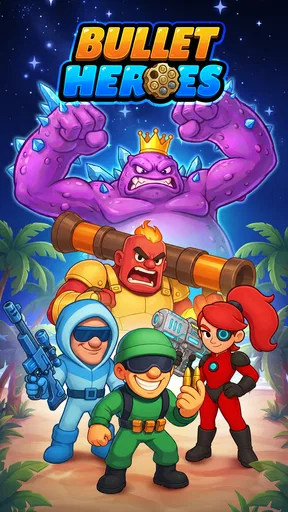
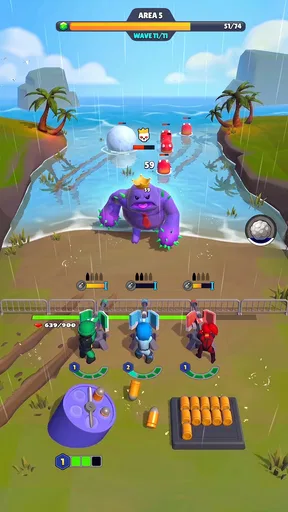
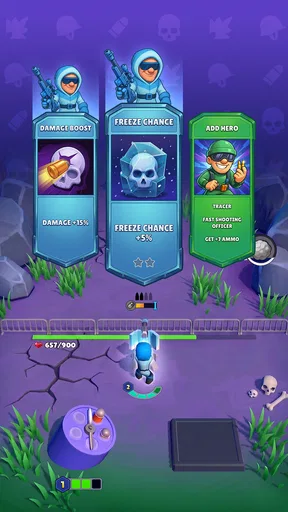
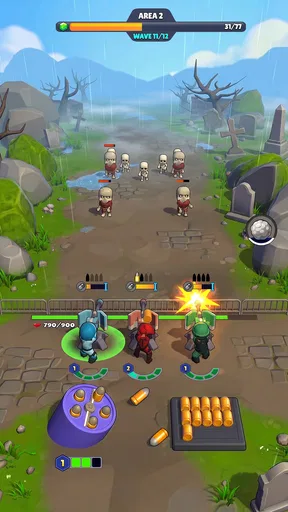
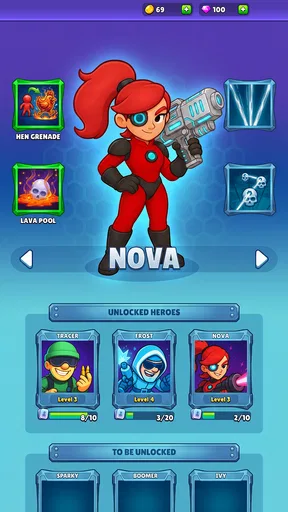
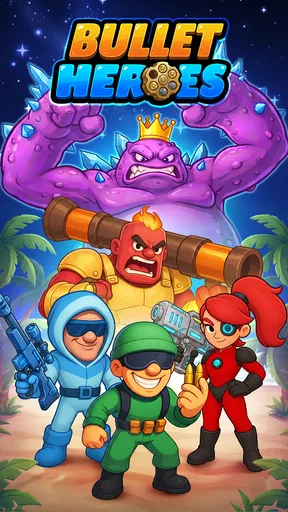
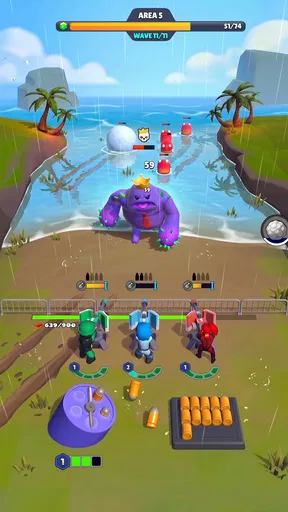
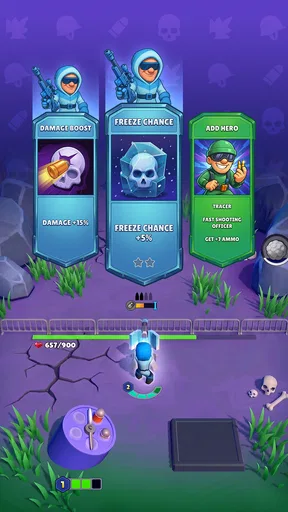
Our Review of Bullet Heroes: TD RPG Shooter
 Analysis by Appyee
Bullet Heroes: TD RPG Shooter is the kind of action game that caught my attention quickly because it combines two familiar ideas: defending a position and improving a character through repeated battles. I spent time with it expecting a short burst of shooting, but the more interesting question turned out to be whether its loop could remain enjoyable after the first excitement faded. My answer is cautiously positive: it is easy to pick up, satisfying in short sessions, and free to start, but its long-term appeal depends heavily on how much repetition you are willing to accept.
Developed by Homa, this action game is built around ammunition, enemy waves, upgrades, and survival. Its central appeal is not a complicated story or a large world to explore. Instead, it asks me to make quick decisions while keeping an eye on firepower and progression. That focused design makes it suitable for a spare moment, although it also means that anyone looking for deep tactical variety may eventually want something more demanding.
How Bullet Heroes feels after the first week
During my first sessions, the controls and objectives felt immediately readable. I did not need a long tutorial to understand the basic rhythm: enter a fight, deal with incoming enemies, collect or earn progress, and use that progress to become better prepared for the next challenge. The tower-defense influence gives the action a defensive pressure, while the shooting element keeps me actively involved rather than simply watching automated units work.
That combination is the strongest part of the design. In a traditional tower-defense game, I usually spend more time planning placement and then observing the result. Here, the survival pressure feels more personal because my own timing and targeting matter. In a conventional shooter, by contrast, the focus is often movement and aiming alone. Bullet Heroes adds a layer of preparation, so each improvement feels connected to the next encounter instead of being just a cosmetic reward.
The first week is helped by the short-session structure. I can play while waiting for an appointment, during a commute break, or at the end of the day when I do not want to commit to a long campaign. A realistic routine would be playing a few rounds after lunch, checking which upgrade path seems useful, and stopping before the repetition becomes tiring. That makes it more practical than a large action game that demands uninterrupted attention.
I also like that the game gives a clear reason to keep trying after a difficult run. Losing does not feel completely empty when the broader progression is still moving forward. This is important for a mobile game because a failed attempt can otherwise feel like time thrown away. The upgrade loop gives each session a small purpose, even when I do not reach the end of a stage.
Still, the opening appeal comes with a warning. The basic structure becomes familiar fairly quickly. Once I understand the relationship between surviving waves and improving my strength, the surprise comes less from discovering new rules and more from handling tougher situations. Players who need constant changes in setting, enemy behavior, or objectives may notice that limitation sooner than players who enjoy polishing a repeatable routine.
What makes the combat loop work
The best decisions are made before a run becomes chaotic. I found it useful to treat upgrades as part of a plan rather than spending every reward immediately on the most obvious improvement. A stronger attack can feel attractive, but survival pressure may make a defensive or resource-focused choice more valuable in the next encounter. This creates a modest but meaningful trade-off: immediate damage is not always the same as reliable progress.
One practical tip is to pay attention to why a run failed instead of automatically repeating it with the same approach. If enemies overwhelm me early, adding more offensive power may not solve the real problem. If I survive comfortably but cannot finish a later wave, then a more aggressive investment may be sensible. The game is at its most engaging when I use each defeat as information rather than treating the upgrade screen as a button-mashing pause.
Another useful habit is to avoid playing indefinitely once concentration drops. Because the action is built around repeated encounters, tired decisions can quickly turn a manageable run into a frustrating one. I get more value from several focused sessions than from one long stretch in which I keep replaying the same section without changing my strategy.
Who will enjoy the first-week experience
This is a good fit for someone who likes mobile survival action but wants more structure than a straightforward arcade shooter. It also suits tower-defense fans who want to participate directly in the fighting instead of relying only on placement. The age rating is Everyone 10+, which places it in a broadly accessible part of the mobile action market, though younger players may still need guidance around optional purchases.
I would recommend trying it to a friend who enjoys visible progression and does not mind replaying familiar battle patterns. It is especially appealing if you prefer games that can be understood in minutes but still offer small decisions about how to strengthen a run. It is less suitable for someone searching for a narrative-heavy adventure, precise competitive multiplayer, or a deep strategy system with many radically different solutions.
The game is free to download, which makes the initial decision easy. However, optional in-app purchases range from $0.89 to $89.99 per item. That broad range is worth noticing before handing the phone to a child or treating the game as a completely cost-free pastime. I can begin without paying, but the presence of purchases means I would personally check device purchase protections first.
Whether the loop holds up from month to month
The month-to-month question is more difficult than the first-week question. Bullet Heroes has a dependable foundation: action, defensive pressure, and character growth reinforce one another. If I enjoy incremental improvement, I can return to it as a compact daily habit. The game does not need to become a major hobby to be useful; it can occupy the same place as other quick mobile games that provide a few minutes of focused activity.
Its recurring value comes from trying to improve decisions, not simply from seeing the same opening again. I can experiment with the order in which I strengthen my capabilities, adjust how aggressively I approach a run, and decide when a safer choice is better than a faster one. Those choices are small, but they give the repetition some personal ownership. Two players can face the same general pressure and still make different mistakes or prioritize different improvements.
That said, the game is not an ideal long-term home for every player. Someone who needs a constant stream of fresh environments or a large collection of modes may find the core loop too narrow. A more traditional tower-defense title may offer greater control over layouts and defensive planning, while a dedicated roguelite shooter may provide more dramatic build variety. Bullet Heroes sits between those alternatives: more active than passive defense, but less expansive than a full strategy or role-playing game.
I would also separate progress from novelty. The first few weeks may feel rewarding because every improvement is noticeable. Later, the satisfaction depends on whether I still care about making a cleaner run or overcoming a familiar obstacle. If the answer is yes, the game can remain a pleasant regular activity. If the answer is no, additional progression alone is unlikely to restore the original excitement.
How I would build it into a routine
My preferred approach is to use it as a deliberate short-session game rather than an always-open background habit. I would play when I have enough attention to make decisions, choose a simple goal for the session, and stop after reaching it. That goal might be testing a different upgrade priority, surviving a difficult section, or finishing a run without spending resources impulsively.
This method also helps with the purchase system. When I am playing with a clear objective, I am less likely to buy something simply because a difficult run was frustrating. I can first ask whether the problem was poor timing, an unsuitable upgrade choice, or a genuine progression wall. Even without treating purchases as automatically negative, separating a strategic decision from an emotional reaction is healthier for a free-to-play game.
For families, I would explain that the game is free to start but not free of purchase prompts. The Everyone 10+ rating makes it approachable, yet it does not replace supervision. I would use device-level purchase controls and make sure the player understands that optional items can cost substantially more than a casual impulse purchase.
What creates fatigue over time
The main source of fatigue is repetition without enough personal discovery. Shooting enemies and surviving pressure can remain satisfying, but the same actions lose impact when I feel that the result depends mostly on repeating a familiar sequence. The game works best when I am still learning how to respond. It works less well when I am only waiting for enough progress to unlock the next improvement.
There is also a mental cost to upgrade decisions that are too similar. If several choices feel interchangeable, the system may look active without giving me a strong reason to care. I prefer upgrades that force a clear trade-off, because then a failed attempt teaches me something. When the decision feels obvious, the pause between battles becomes administration rather than strategy.
Short sessions reduce this problem but do not remove it. I can stop before I become bored, yet I may also feel that the game is better in small doses than as a central daily game. That is not necessarily a flaw. Many mobile titles are strongest when treated as compact entertainment, and expecting a free action game to provide endless variety can create an unfair standard. Still, readers deciding whether to keep it installed should know that its value is likely to be measured in repeatable moments, not unlimited freshness.
Another possible frustration is the temptation to chase progress after a disappointing run. Because the next upgrade always appears close enough to pursue, I can keep playing beyond the point where I am enjoying myself. My practical solution is simple: if I fail twice for the same reason and have no new plan, I stop and return later. That rule prevents the game from turning a short break into a cycle of irritation.
Maintenance, updates, and the cost of keeping it installed
From a maintenance perspective, the game is relatively easy to keep available. It is free, supports devices running Android 7.1 or later, and its current version is 121.3. That broad compatibility makes it accessible on many older phones, although actual comfort will still depend on the device and how smoothly it handles action on screen.
The developer is Homa, a name associated here with a compact, replayable mobile format rather than a single enormous campaign. For me, that means the decision to keep it installed depends less on storage as an abstract concern and more on whether I am actually returning to the loop. If I have not played for several weeks, the game is not earning its place simply because the download was free.
One maintenance advantage is that the premise is easy to remember. I do not need to relearn a complicated story or a large control scheme after a break. I can return, review my current progression, and understand the immediate goal. That makes it more convenient than games that punish a long absence with dense systems or time-consuming catch-up.
The trade-off is that a simple return can also expose how little has changed for me. If the first few rounds after reinstalling feel exactly like the rounds I abandoned, there may be no strong reason to make it a permanent fixture. I would keep it installed while it fills a specific role—quick action with upgrade decisions—and remove it when another game serves that role better.
The current store presence shows an average rating of 4.0 from around 8.5 thousand ratings, with roughly 490 written reviews and over 1 million installs. Those figures suggest that it has found a substantial mobile audience, but they do not decide whether it belongs on my phone. I see them as a sign that the basic format is understandable to many players, not as proof that the long-term loop will suit everyone.
When another type of game is the better choice
If I want careful map construction, I would choose a dedicated tower-defense game instead. Those games generally make placement, timing, and lane management the main event, whereas Bullet Heroes keeps the player closer to direct action. If I want a story, exploration, or a large character roster, I would look toward a fuller role-playing game. If I want highly precise shooting and competitive mastery, a specialized shooter would probably be a better investment of my time.
Where this game makes more sense is in the middle ground. It gives me enough defensive planning to make upgrades matter, but it does not ask me to study a large rulebook. It gives me enough shooting to keep my hands involved, but it does not require the commitment of a console-style campaign. That balance is convenient, provided I accept that convenience comes with a narrower ceiling.
I would skip it if I strongly dislike free-to-play progression, even when the game can be started without payment. The purchase range is too broad for me to ignore, especially on a shared family device. I would also skip it if repetition quickly bothers me or if I need every session to introduce a new mechanic. The game’s strengths are consistency and accessibility, not endless reinvention.
My long-term verdict
After the novelty fades, Bullet Heroes: TD RPG Shooter earns a place as a reliable short-session action game rather than an essential long-term favorite. I enjoy the way it blends active shooting with defensive survival, and I appreciate that each run can encourage a small adjustment in strategy. The opening is approachable, the progression gives failed attempts some value, and the free starting point makes it easy to test personally.
Its lasting weakness is the same feature that makes it convenient: the focused loop. Once I have learned its rhythm, the game needs my own goals and self-imposed limits to stay interesting. It does not fully replace a deep tower-defense game, a broad role-playing adventure, or a dedicated shooter. Instead, it works as a bridge between those categories for players who want a little of each without a large commitment.
My recommendation is to keep it installed only if its short, repeatable battles fit a real habit. Play it during brief breaks, use upgrades thoughtfully, and treat purchases as optional rather than as a solution to frustration. If that routine still feels satisfying after several weeks, the game has earned its space. If every session becomes a replay of the same plan, uninstalling it is reasonable; the first-week appeal is genuine, but long-term value depends on whether you enjoy refining the loop more than chasing constant novelty.
For the right player, this is a friendly and accessible entry into tower-defense action with enough progression to support regular visits. For everyone else, it is best viewed as a polished trial rather than a permanent commitment. I would recommend giving it a fair test, especially if you like survival pressure and upgrade choices, while keeping realistic expectations about repetition and the ongoing pull of optional purchases.
Privacy and Permissions
See what permissions an app requests and how it handles your data.
- Location
- approximate location (network-based)
- Wi-Fi connection information
- view Wi-Fi connections
- Other
- view network connections, pair with Bluetooth devices, access Bluetooth settings, connect and disconnect from Wi-Fi, full network access, control vibration, prevent device from sleeping, Google Play license check
Verdict
Strengths of Bullet Heroes: TD RPG Shooter
- Fast-paced shooting makes tower defense feel more active and engaging.
- Hero abilities add variety and let you adapt to different enemy waves.
- Short missions work well for quick gaming sessions.
- Multiple heroes encourage experimentation with different playstyles.
- Cartoon visuals are colorful and easy to read on smaller screens.
Limitations of Bullet Heroes: TD RPG Shooter
- Difficulty can rise sharply, especially when upgrades fall behind.
- Repeated missions may feel grindy when farming resources.
- Some progression elements may encourage in-app purchases.
- The screen can become crowded during busy enemy waves.
- Performance may vary on older phones during intense battles.
Other Releases by Homa
View All
Attack Hole - Black Hole Games
Arcade4.2

Agent Hunt – Hitman Shooter
Action4.5

Merge Master: Dinosaur Monster
Arcade4.2

Farm Land - Farming life game
Adventure4.5
Similar Picks in This Category
View All
Temple Run 2: Endless Escape
Imangi Studios4.1

PUBG MOBILE
Level Infinite4.3

Free Fire: 9th Anniversary
GARENA INTERNATIONAL I4.4

Talking Tom: Hero Dash Run
Outfit7 Limited4.3

slither.io
Lowtech Studios3.9

Sniper 3D:Gun Shooting Games
Wildlife Studios4.6
Frequently Asked Questions
What is Bullet Heroes: TD RPG Shooter?
Bullet Heroes: TD RPG Shooter combines tower defense strategy with RPG progression and shooter-style combat. You defend areas against waves of enemies while deploying or improving heroes with different abilities. The gameplay generally involves choosing suitable units, managing upgrades, and reacting quickly to enemy attacks, making it more active than a traditional tower defense game.
How does the gameplay work in Bullet Heroes: TD RPG Shooter?
Each stage challenges you to stop incoming enemy waves by positioning heroes and using their attacks or special skills at the right time. As battles become more difficult, you need to improve your characters, select useful combinations, and adapt your strategy to different enemy types. Success depends on both planning your defense and making timely combat decisions.
Can Bullet Heroes: TD RPG Shooter be played offline?
Offline availability may depend on the specific mode, version, and features included by the developer. Core gameplay can sometimes work without a constant connection, but online access may still be required for advertisements, cloud saves, events, updates, purchases, or account-related functions. It is best to check the store listing and test the game after installation before relying on it offline.
Is Bullet Heroes: TD RPG Shooter free to download and play?
The game is typically offered as a free download, allowing players to begin without paying an upfront purchase price. However, free-to-play games may include optional in-app purchases, rewarded advertisements, premium currency, or upgrade systems. You can usually progress without spending money, although purchases may shorten waiting times or provide additional resources and customization options.
What devices are compatible with Bullet Heroes: TD RPG Shooter?
Compatibility depends on the operating system, device model, available storage, and the minimum version supported by the developer. Before downloading, review the official Google Play or App Store listing to confirm the requirements for your phone or tablet. Keeping your operating system updated and having sufficient free space can also help prevent installation problems or performance issues.
Play our best games!


